Owner Questions

Bethlehem Commercial Roofing FAQ

Straight Answers on Membranes, Drains, Weather, and Scope

This Bethlehem commercial roofing FAQ answers the questions owners and facility managers ask before a TPO, EPDM, industrial, or metal reroof.

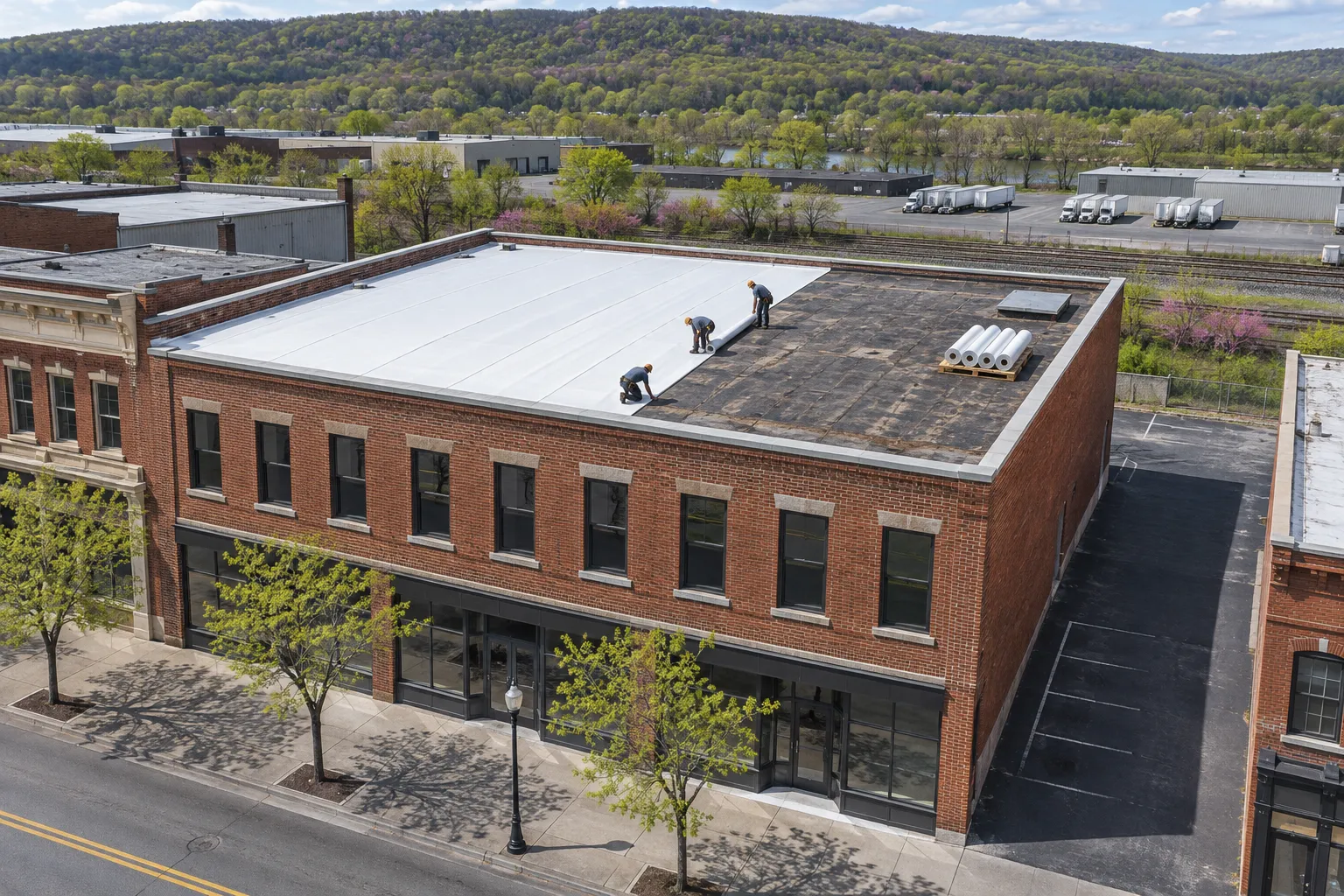
Roofers laying white TPO over half of an old flat roof on a two-story brick commercial building

Bethlehem Commercial Roofing FAQ by Topic

We grouped the Bethlehem commercial roofing FAQ into seven topics. Pick one to jump to its answers.

Planning a Commercial Roof in Bethlehem

What gets checked first, what a full scope covers, winter work, and comparing bids.

What should a Bethlehem roofer establish before proposing a replacement?

A roofer should establish the existing assembly, moisture condition and practical removal sequence before proposing replacement. For Bethlehem, PA buildings, we would inspect deck concerns, equipment connections and access over occupied areas. The recommendation should explain how the new roof addresses those findings rather than begin with a material selected without examining the building.

Does commercial roofing include more than installing a new covering?

Commercial roofing includes the supporting layers and connections needed for the covering to function as part of the building. We address insulation, drainage, edge metal and flashing alongside the membrane or panels. Equipment penetrations and retained roof sections also need proper details, so the visible surface is only part of the scope.

Can a commercial roof replacement proceed during Bethlehem’s winter weather?

Winter replacement can proceed when safe access and conditions suitable for the selected system can be maintained. In Bethlehem, PA, we would plan temporary closures and check for snow, ice and wet substrates before opening areas. Snowmelt routes at gutters and drains also need consideration when deciding how each section can be protected.

How can an owner compare two commercial roofing proposals fairly?

An owner can compare proposals fairly by checking that removal, insulation, attachment and detail work describe equivalent scopes. We would review allowances for concealed damage and coordination around equipment as well. A lower-looking figure can reflect omitted work, so the comparison needs clear assumptions about access, protection and retained components.

TPO Membrane Questions

Heat-welded seams, overlays over wet layers, cold-surface welding, and price drivers.

What does TPO contribute to a complete commercial roof?

TPO supplies a thermoplastic polyolefin membrane joined with heat-welded seams within the complete roof assembly. We plan that covering with matching insulation, substrate and attachment rather than specify the sheet alone. Flashing at curbs and edges must connect correctly, while drainage and maintenance access shape how the roof is laid out.

Which building conditions affect the price of TPO installation?

A roof inspection sets the TPO installation price for the specific building. We assess area, system and thickness, insulation, tear-off layers, deck repairs, edge metal, flashing and rooftop equipment. Access, staging and season influence the scope too, particularly where new work must be coordinated with operations under the roof.

Is a TPO overlay suitable when moisture remains in the old roof?

Moisture in the existing assembly needs investigation and appropriate treatment before a TPO overlay is considered. We establish which layers remain usable and how the new system would be attached. Covering wet insulation or deteriorated support can retain the old problem beneath an otherwise new membrane and complicate later repairs.

How should TPO installation change when the roof surface is cold?

Cold surfaces require checking the selected TPO system’s preparation, joining and attachment requirements before installation continues. We examine frost and moisture and verify welding under the actual conditions. Where adhesives are part of the assembly, their application limits also matter; a schedule should not override conditions needed for a sound connection.

EPDM Rubber Roof Questions

Rubber roof basics, what sits under the sheet, lifespan, and freeze-thaw checks.

Why is EPDM commonly described as rubber roofing?

EPDM is a synthetic rubber sheet used in commercial roof assemblies, which explains the common description. We still identify the exact system before selecting seams, flashing or repairs because the nickname leaves many components unnamed. Insulation, attachment and drainage need to suit the building along with the membrane itself.

What should an EPDM project price account for beneath the membrane?

An EPDM price must account for the existing assembly and work identified by a roof inspection. We evaluate area, system and thickness, insulation, tear-off layers, deck repair, edge metal, flashing and equipment. Access, staging and season also enter the scope, so the building’s replacement cost depends on far more than the sheet material.

Can an average EPDM lifespan tell us whether our roof needs replacement?

An average lifespan cannot determine whether a particular EPDM roof needs replacement. We examine seams, stress at edges, punctures and moisture beneath affected areas to judge condition. Maintenance history and exposure may explain why sections differ, while the decision should address current defects rather than promise performance until a particular age.

Where should EPDM be checked after repeated freezing and thawing?

Drainage areas and vulnerable seams or flashing are where EPDM should be checked after freeze-thaw conditions. We look for water held near outlets, stressed edges and signs of moisture reaching damaged details. Even a flexible membrane needs secure connections and a clear route for runoff from the roof.

Have a Question About Your Own Roof?

Answers here cover the common cases. A look at your roof covers the rest, from the deck under the insulation to the drains at the edge.

Schedule Your Free Inspection
What To Have Ready
  • The property address
  • What you see inside when it rains
  • Any past repair or roof records
  • Who to call to get roof access

Industrial Roof Questions From Plant Managers

Production exposure, equipment around the roof, and walkway layout.

What distinguishes roofing for an operating industrial building?

Industrial roofing must account for production conditions, equipment and the consequences of opening the roof above active work. We assess exhaust, humidity and service traffic alongside the assembly design. Material choice and construction sequence should fit those exposures, rather than treating the facility as an empty building with an ordinary roof area.

How does equipment coordination affect an industrial roofing budget?

Equipment coordination can affect access and sequencing within an industrial roofing budget. A roof inspection sets the price after we assess size, system and thickness, insulation, tear-off layers, deck repair, edge metal, flashing and equipment. Staging and season also matter, so the proposal should identify the work needed around operating machinery.

Which roof features matter most above manufacturing processes?

Roof features should match the actual manufacturing exposure, especially at exhaust outlets, equipment routes and openings above sensitive processes. We consider drainage, insulation and interior moisture before choosing the assembly. The installation plan must also identify protection or isolation needed below areas being removed, rather than assume production can remain unrestricted.

Should walkway pads follow every possible route across an industrial roof?

Walkway protection should follow the planned routes needed for equipment servicing, not automatically cover every possible path. We consider membrane compatibility, access points and details that need inspection. The layout must keep runoff and drains clear, while reducing unnecessary traffic over vulnerable roofing connections that are outside regular service routes.

Commercial Metal Roof Questions

Installed price, panel detailing, wet snow, and retrofit framing.

What affects the installed price of a new commercial metal roof?

A roof inspection establishes the price of the proposed metal assembly and related work. We assess size, system and thickness, insulation, tear-off layers, deck repair, edge metal, flashing and rooftop equipment. Access, staging and season help define installation requirements; a panel-only comparison leaves out important parts of the actual project.

How can roof detailing influence the life of new metal panels?

Sound detailing can affect metal roof serviceability by managing movement, water paths and connections at penetrations. We examine compatible materials, fastening and future access when designing the assembly. Panels alone cannot compensate for a weak flashing or attachment detail, and the service-life assessment should reflect those connections rather than a fixed term.

Does a metal covering establish how much wet snow a roof can carry?

A metal covering does not establish the roof structure’s allowable snow load. We need the complete assembly and supporting connections considered through qualified design review. Heavy wet snow and drifting around higher sections or equipment require attention to that structure, without guessing a safe load or removal threshold from panel appearance.

What must be checked before adding metal retrofit framing?

Retrofit framing needs a designed connection to existing supports capable of carrying the proposed assembly. We inspect relevant structural conditions and roof geometry before planning new slopes or attachment points. Added framing should not be selected solely to improve drainage while leaving the condition and load path of the building beneath unresolved.

Ownership, Weather, and Code Questions

Membrane choice for warehouses, insurance, humid brick buildings, storms, and the state code.

Should a logistics warehouse compare TPO and EPDM by material name alone?

A logistics warehouse should compare complete TPO and EPDM assemblies, including seams, attachment and maintenance demands. We consider service routes, equipment and drainage before recommending either membrane. The material name leaves out how the system will meet roof edges or retained components, which can determine whether the design fits the building.

Can a new roof be counted on to lower a medical office’s insurance cost?

A new roof should not be counted on to lower insurance costs automatically. The policy and insurer’s assessment determine any change, including how existing damage is treated. We can provide the roofing scope and condition information, but the medical office should discuss coverage and premiums directly rather than assume a saving in its project budget.

Why investigate humidity before reroofing a brick industrial building?

Humidity should be investigated because moisture within a brick industrial building can affect insulation and roof components independently of rain leakage. We compare condensation evidence with wall and flashing conditions before defining replacement work. A new outer covering cannot be expected to correct an interior moisture source that remains active beneath it.

What should summer storm checks cover on recently completed roofing?

Summer storm checks should cover punctures, loose perimeter details and disturbed flashing as well as the roof’s open surface. We examine hail and wind effects after access becomes safe, including debris at outlets. New damage can occur on a recent installation, so repairs should follow the observed condition rather than the roof’s age alone.

Which code framework guides a Bethlehem commercial reroofing review?

Pennsylvania uses the Uniform Construction Code as its statewide framework. For Bethlehem, PA reroofing, we would describe the existing assembly and proposed changes to the reviewing authority. Removal limits, insulation and any work affecting supports should be clear so the discussion addresses the building’s actual project rather than only its replacement covering.

Questions From Owners in Nearby Towns

Warehouses, edge metal, office equipment, drainage, and rooftop service routes.

What should a Perkasie warehouse examine before selecting replacement roofing?

A Perkasie warehouse should examine moisture, deck condition and drainage before settling on replacement roofing. We also assess access around deliveries and the protection needed for stored contents. Those findings define what can remain and how work can proceed, so the covering choice follows an understood assembly and operating plan.

Can new roofing in Hatboro retain old edge metal?

Old edge metal in Hatboro may remain only if its condition and connections suit the replacement assembly. We examine attachment, joints and compatibility with the new flashing before including it as retained work. Renewing the roof surface while leaving defective perimeter components can preserve a water-entry path beside the new installation.

How should Doylestown office equipment be handled during reroofing?

Office equipment in Doylestown needs coordination where reroofing affects curbs, supports or connections. We identify any required isolation or adjustment before roof removal reaches those areas. The sequence should keep responsibilities clear between roofing and equipment work, so new membrane is not later disturbed to complete a detail omitted from the plan.

Could a Glenolden replacement roof need drainage changes?

A Glenolden replacement needs drainage changes if existing low areas or obstructed runoff have contributed to roof problems. We assess outlets, insulation shape and the surrounding structure before defining corrections. Installing a new covering over the same arrangement can leave recurring water collection unresolved, even when the membrane itself is renewed.

Where should service routes be planned on an Ambler commercial roof?

Service routes on an Ambler roof should connect safe access points with equipment needing attention while avoiding unnecessary traffic over vulnerable details. We consider compatible walkway protection and room to inspect drains or flashing. The walkway route must also preserve runoff paths rather than introduce barriers that interfere with the roof’s drainage.

Still Have a Question After the Bethlehem Commercial Roofing FAQ?

If your question is about a specific roof, send the address or call. We will look at the building and answer with what we find on it.

Call Us (835) 214-7704